Annealing colors on stainless steel and titanium - explained simply
A compact and technically clean explanation of color annealing with a fiber laser.
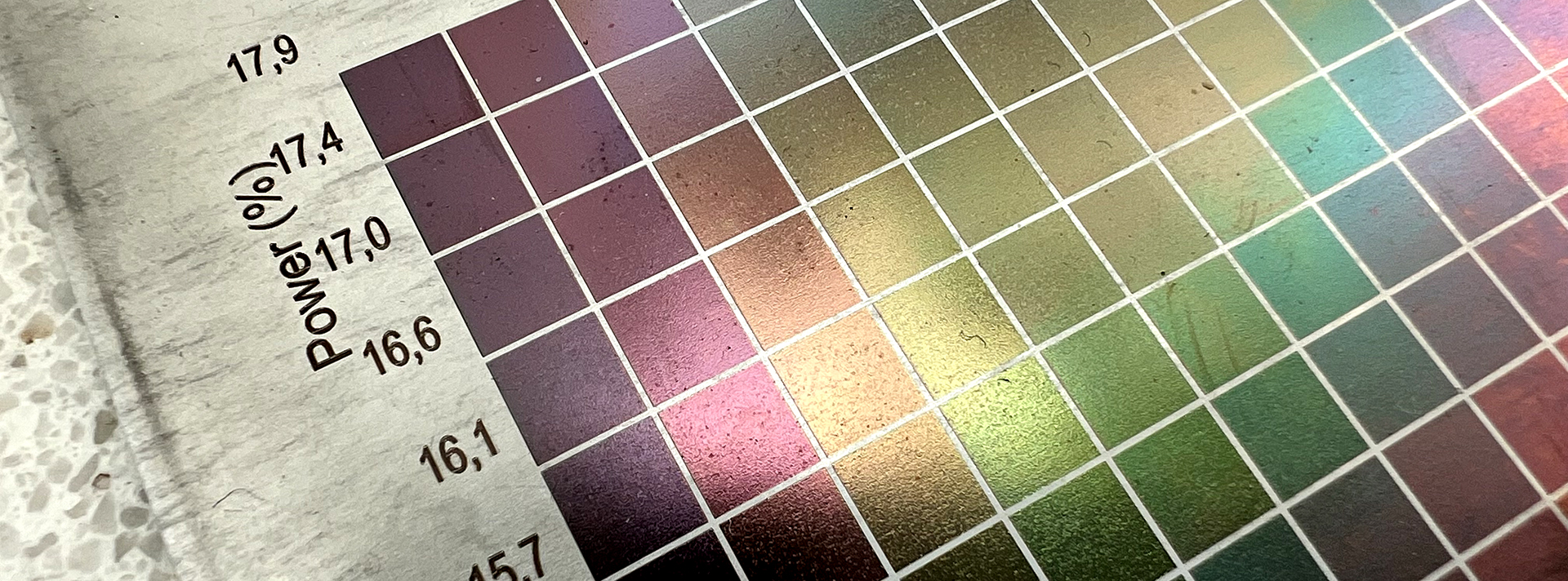
What are annealing colors?
When stainless steel or titanium is heated in a controlled way, the surface reacts with oxygen in the air. This forms an extremely thin oxide layer. Depending on the thickness of this layer, light is reflected differently and visible colors appear.
- Yellow
- Brown
- Violet
- Blue
- Turquoise
How does a fiber laser create annealing colors?
A fiber laser introduces energy very precisely into the metal surface. The goal is not mainly material removal, but controlled heating.
Typical control variables are:
- lower power
- specific pulse duration
- defined frequency
- adjusted speed
- multiple passes (layers)
The interaction of all parameters is always decisive. Even small changes can visibly shift the color tone.
Why do stainless steel and titanium work especially well?
Stainless steel and titanium are especially suitable because they form stable and uniform oxide layers.
- stable oxide-layer formation
- uniform color effect
- good adhesion of the oxide layer
- high contrast
Which colors are possible?
Typical annealing colors are metallic tones such as:
- golden yellow
- straw yellow
- brown
- reddish brown
- violet
- blue
- light blue
- turquoise
Very strong red or pure green are technically hard to achieve in a stable way. Annealing colors are always slightly metallic and can shift depending on viewing angle.
Advantages
- No paint and no chemicals required
- Very high level of detail
- Clean process without additives
- No flaking coating
- Ideal for logos, markings, and labels
- Good repeatability within one system
Disadvantages and limits
- Works reliably mainly on stainless steel and titanium
- Surface finish strongly affects the result
- Not as scratch-resistant as deep engraving
- Color tone can change under heavy weather exposure
- Parameters react sensitively to small changes
- No freely selectable full-color printing
Difference between color marking and engraving
In classic laser engraving, material is removed and a recess is created. With annealing colors, the surface remains almost smooth.
- no significant material removal
- smooth surface
- color through oxide layer
- hardly any tactile depth
What influences the color result?
- material composition
- surface finish
- surface cleanliness
- laser parameters
- focus position
- oxygen availability
- heat dissipation in the workpiece
In practice, color values are therefore determined with test samples and not only from tables.
Quick practical FAQ
Why can colors differ even with the same numbers?
Material batch, surface finish, focus position, and heat in the part change the effective energy input. Always start with small test fields on the real workpiece.
Which data makes a parameter entry truly useful?
Most important are material, color, laser brand/model, lens, power, speed, frequency, Q-Pulse, and a reference image. That makes reproduction much easier.